
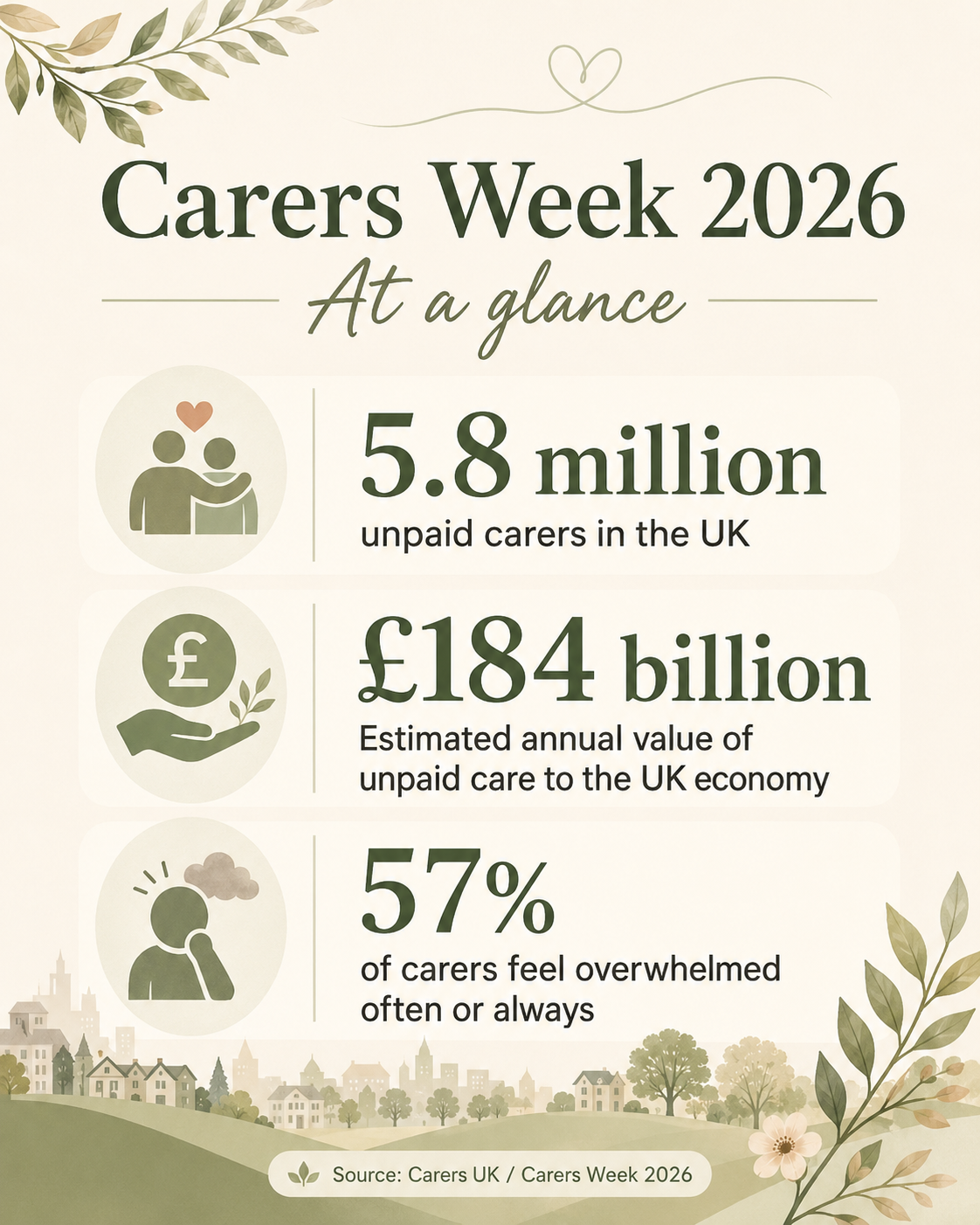
Carers Week 2026 takes place across the UK from Monday 8 June to Sunday 14 June. This year’s theme is Building Carer Friendly Communities — a call for all of us, individually and collectively, to look more carefully at the people around us who may be carrying far more than we realise. Across the UK, an estimated 5.8 million people provide unpaid care to someone they love.
It is a week to recognise the millions of people who quietly support somebody else each day: a parent, partner, child, relative, friend or neighbour who may be living with illness, disability, frailty, addiction, or a mental health condition.
Some people have cared for years. Others have recently found themselves stepping into a caring role with very little preparation. Many do not initially describe themselves as carers at all. They simply see themselves as somebody doing what needs to be done for a person they love.
But that work matters.
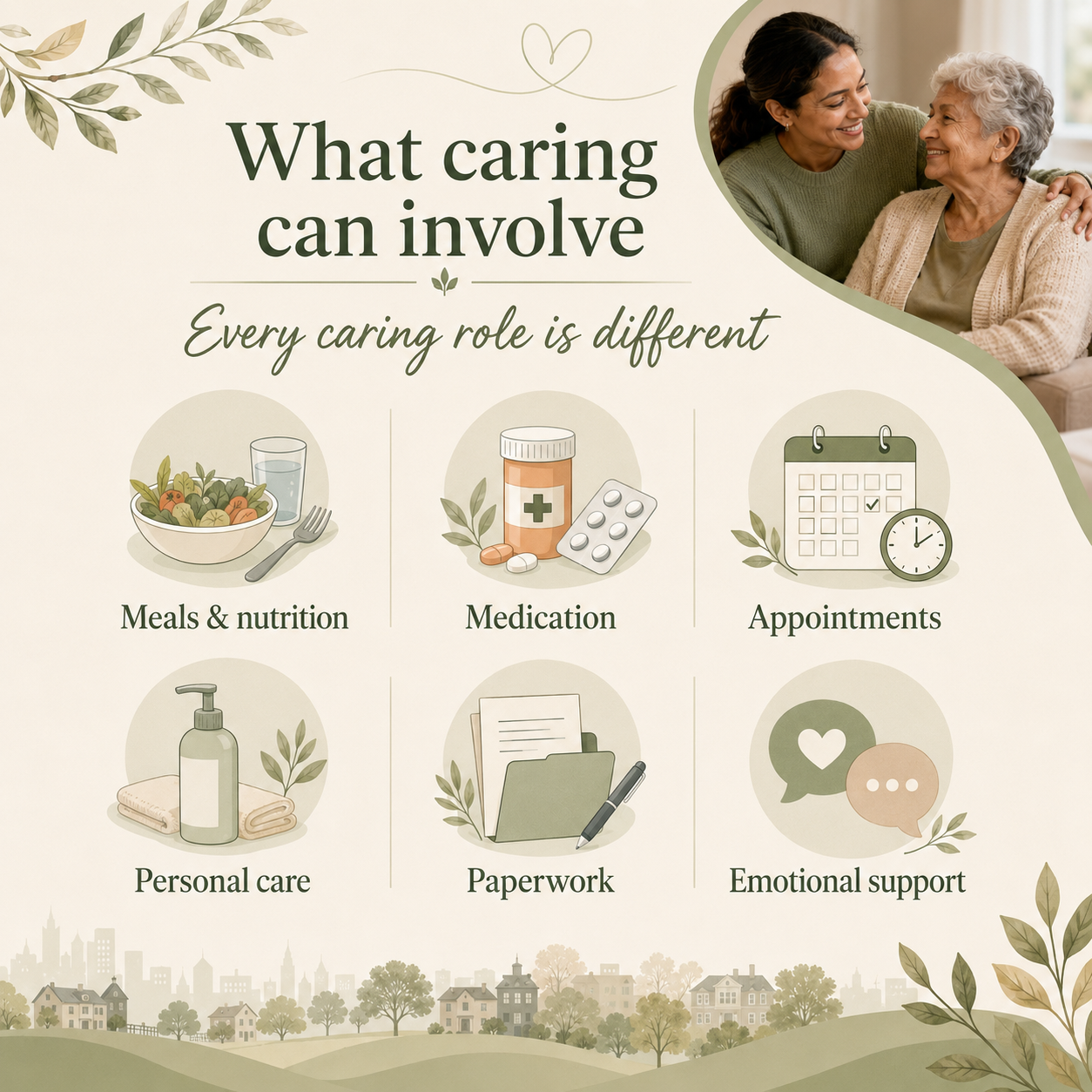
It may involve preparing meals, managing medication, attending appointments, making phone calls, arranging care, handling paperwork, helping with personal care, offering emotional reassurance, or remaining alert through the night. It often happens behind closed doors and alongside jobs, families, financial pressures, and the ordinary demands of daily life.
Carers Week is a chance to bring that work into the light.
Building Carer Friendly Communities
The theme for Carers Week 2026 is Building Carer Friendly Communities.
A carer friendly community is not defined by a single organisation or service. It is created when people begin to notice, understand and respond to the realities of caring.
It can be a GP practice that listens carefully when a carer says they are struggling. A workplace that allows greater flexibility. A school or college that recognises the responsibilities carried by a young carer. A pharmacy that offers practical guidance. A local business that makes life slightly easier. A neighbour who checks in. A family member who offers meaningful help rather than waiting to be asked.
Small actions can make a considerable difference.
Caring can be deeply rewarding, but it can also be exhausting and isolating. It can affect a person’s physical health, emotional wellbeing, relationships, employment, finances and sense of identity. Too many carers are expected to navigate complicated systems while already carrying an enormous amount of responsibility.
A supportive community cannot remove every difficulty. It can, however, make sure that carers are recognised, respected, listened to and not left to cope alone.
A different focus each day
Throughout Carers Week 2026, the national campaign will explore the different places where more carer friendly communities can be created:
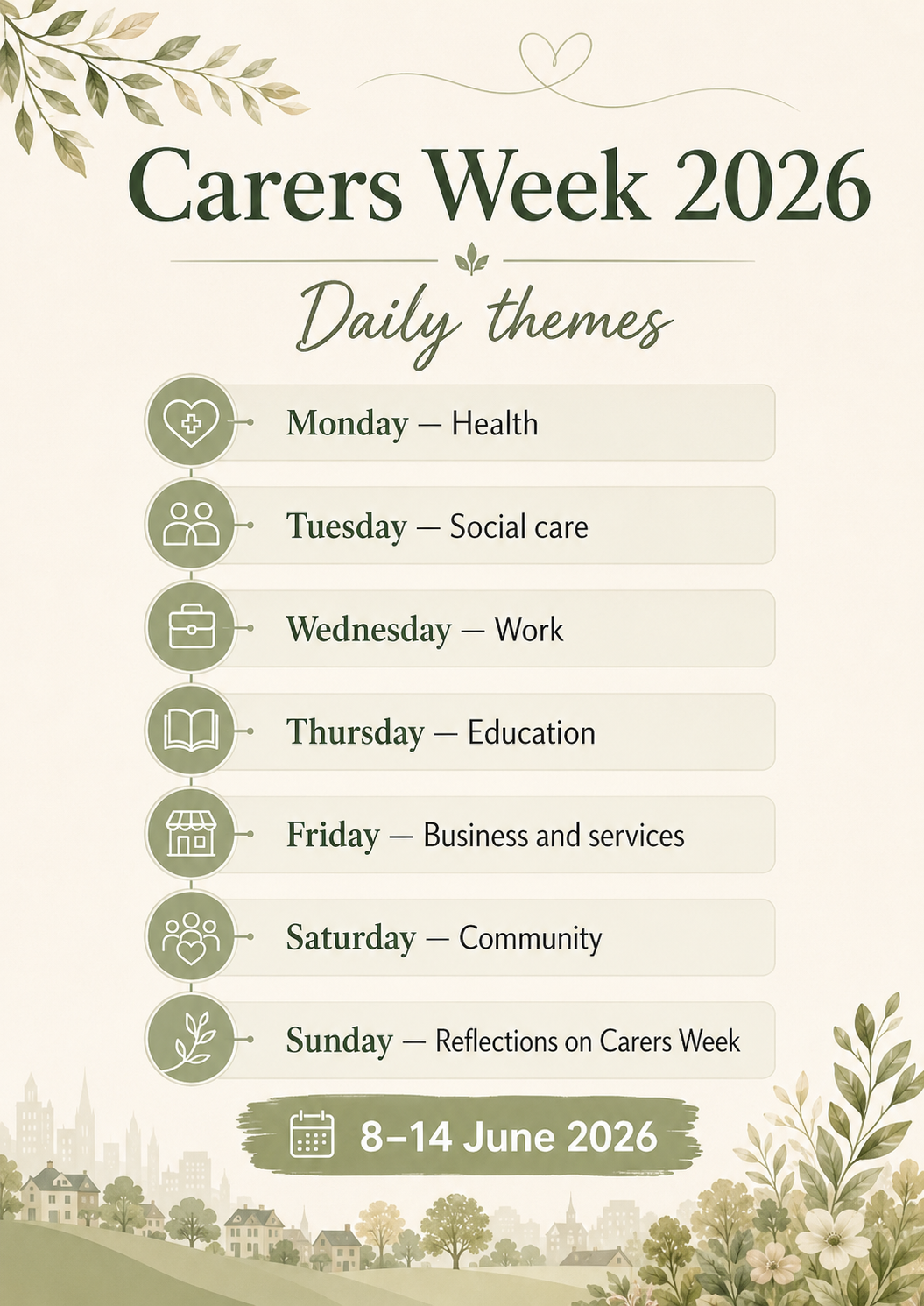
- Monday: Health — Recognising the importance of carers within GP practices, hospitals, pharmacies and healthcare settings — and remembering that carers have health needs of their own.
- Tuesday: Social care — Looking at the support carers need when navigating assessments, services, care arrangements and local authority systems.
- Wednesday: Work — Highlighting the challenges of balancing employment with caring responsibilities and the value of understanding, flexible workplaces.
- Thursday: Education — Recognising young carers and student carers, whose responsibilities can affect their studies, opportunities and wellbeing.
- Friday: Business and services — Encouraging organisations, retailers and service providers to consider how their policies and everyday interactions can better support carers.
- Saturday: Community — Celebrating the difference made by local groups, charities, neighbours, friends and informal networks of support.
- Sunday: Reflections on Carers Week — Taking time to consider what we have learned — and how awareness can be turned into lasting action beyond a single week.
More than a week of awareness
Awareness matters, but carers need more than kind words.
They need clear information. They need practical support. They need services that communicate properly with one another. They need opportunities to rest. They need their concerns to be taken seriously. They need systems that are easier to navigate, especially during times of illness, crisis or change.
They also need to know that asking for help is not a sign of failure.
No one should be expected to carry everything alone.
Carers Week gives all of us an opportunity to look more carefully at the people around us. There may be somebody in our family, workplace, street or community who is carrying far more than we realise.
A simple question can be a good place to begin:
How are you managing — and is there anything that would genuinely help?
This week at The Caregiver’s Diary
At The Caregiver’s Diary, we believe that carers deserve a space where their experiences are understood honestly and without judgement.
Throughout Carers Week, we will be sharing information, reflections and practical resources for people at different stages of the caring journey: from those who are only beginning to recognise themselves as carers to those who have been supporting somebody for many years.
We will also be looking at the wider systems around caring: health, social care, work, family life, wellbeing, advocacy and the importance of finding support before the pressure becomes overwhelming.
There is no single experience of caring. Every family, every relationship and every situation is different.
But nobody should feel invisible.
A message to carers
This Carers Week, we want to say something simple.
Your work matters.
The meals prepared, appointments remembered, forms completed, medicines collected, difficult conversations handled, sleepless nights endured and quiet acts of reassurance may not always be seen by the wider world.
But they matter enormously.
Whether you provide a few hours of support each week or care for somebody around the clock, you deserve recognition, information, respect and support.
Welcome to Carers Week 2026.
Let us use this week not only to celebrate carers, but to help build communities that truly stand beside them.
Find out more: Visit the official Carers Week website to explore events, campaign resources and information for carers in your area.
Need support? If you are looking after somebody and feel unsure where to begin, visit our guidance pages for practical information and signposting.

Are you a confident carer?
Take the Caregiving Confidence Quiz to find out where you stand — and get guidance tailored to your situation.