
For Carers
Safeguarding
Recognising when something isn’t right — and understanding what that means.
Safeguarding describes the process of protecting someone from harm. In practice, it rarely begins with anything obvious.
More often, it starts quietly. A concern that doesn’t quite sit right. A pattern you can’t fully explain yet. Something that feels slightly off, even if you can’t point to a single reason.
The language around safeguarding can feel formal, sometimes distant. In reality, it’s much simpler than that.
It’s about noticing what’s happening, keeping track of it, and responding when something doesn’t feel right.
In most situations, harm doesn’t appear all at once. It develops gradually. And the people closest to the situation are usually the first to see it — even before they can explain it.
This page sets out what those early signs can look like, how they tend to develop, and what to pay attention to as things become clearer over time.
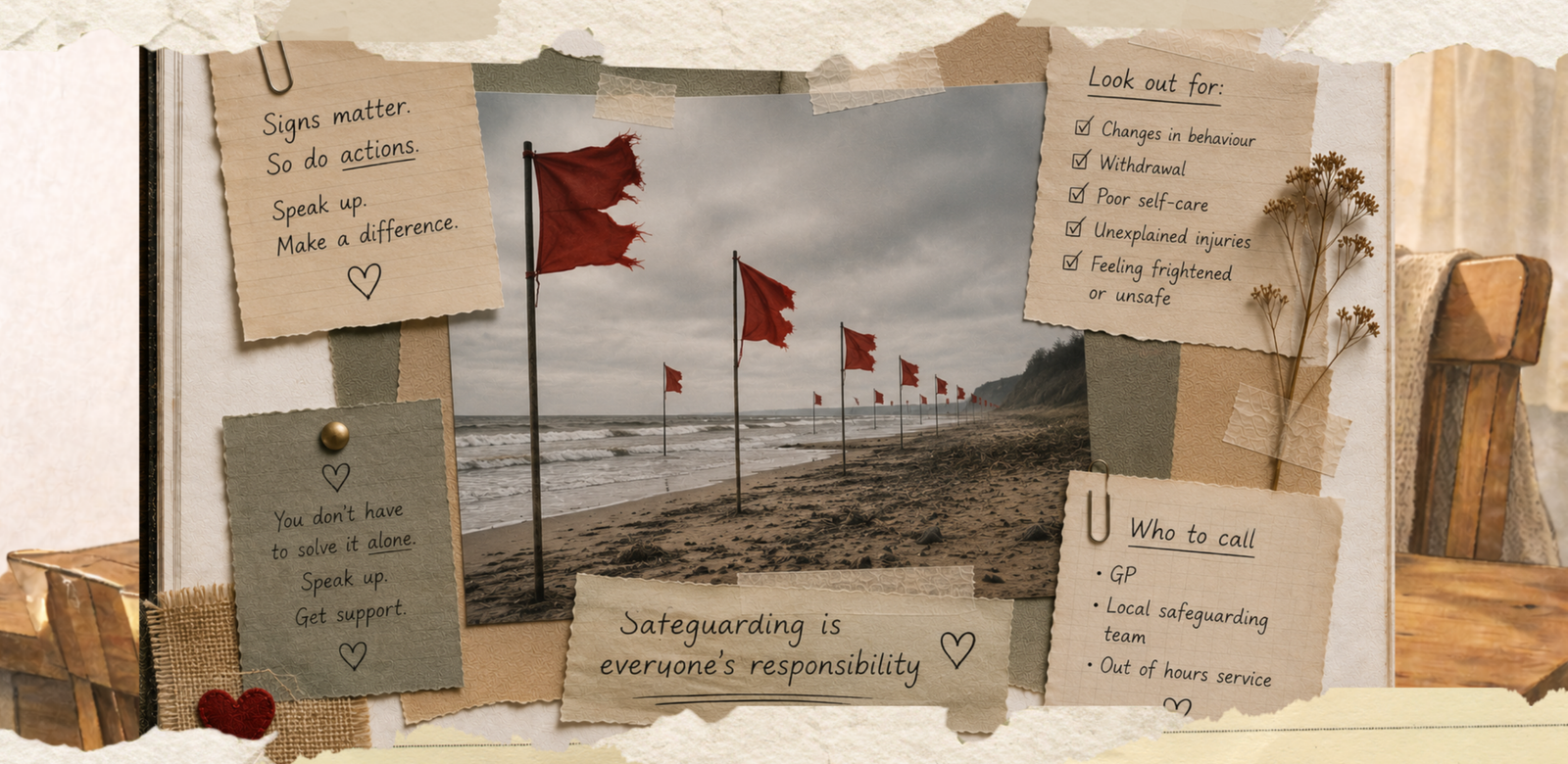
Red flags
Early signs that something may not be right — patterns worth taking seriously before they become harder to explain.
When things escalate
Signs that a situation is becoming more serious, and what to look for as concern grows.
Legal frameworks
The protections that exist in UK law — explained plainly, not in policy language.
Early signs
Red flags
These are often the first signs that something may not be right. Not proof — but patterns that start to form over time.
In most cases, you notice something before you can properly explain it.
Subtle changes or things not feeling right
This is usually where it starts.
Not with anything obvious — just a shift. Something slightly different in how things feel, how someone responds, or how situations unfold.
It’s easy to brush off at first, especially when you can’t point to one clear thing. But in care situations, small changes can matter. They are often the first signs that something needs closer attention.
This is often the hardest stage to explain, because nothing may look serious on its own.
You may notice a change in atmosphere. A conversation feels different. Someone seems less relaxed than usual. A family member, professional, or visitor starts behaving in a way that feels slightly out of step with what you know of the situation.
The person you care for may seem quieter, more uncertain, more easily led, or less willing to speak openly. They may change the subject quickly. They may avoid saying what they really think. Or they may seem fine in one moment, then different as soon as another person enters the room.
At this point, it is easy to doubt yourself. Many carers do. You may tell yourself you are tired, overthinking, or being too sensitive. But caregiving often places you close enough to notice what others miss. That does not mean you should assume the worst. It means you should pay attention.
Ask yourself what has changed.
Is the person behaving differently with certain people? Are conversations becoming harder? Are decisions being made in a way that feels unusual? Has someone started controlling access, information, money, medication, appointments, or communication?
The important thing is not to prove anything immediately. The important thing is to notice it, write it down, and see whether it happens again.
A single moment may not mean much. Repeated moments do.
What to record: the date, what felt different, who was present, what was said, how the person responded, and whether the same kind of change happens again.
Changes in behaviour or communication
You might notice someone speaking less, or differently.
Conversations may not flow in the same way. Answers may become shorter, more guarded, or harder to read. Sometimes there are pauses where there did not used to be.
None of this proves anything on its own. But when behaviour or communication changes, it is worth paying attention.
Changes in communication can be easy to miss at first, because they often look small from the outside.
Someone may still be speaking. They may still answer questions. They may still say they are fine. But the way they communicate can begin to change. Their answers may become shorter. They may seem careful with their words. They may look to someone else before replying, or stop talking when another person comes into the room.
Sometimes the change is in tone rather than words. A person who was usually open may become flat, anxious, distracted, or unusually agreeable. They may avoid certain subjects. They may repeat phrases that sound as though they have come from someone else. They may describe events differently from how they described them before.
This does not automatically mean they are being influenced or harmed. Illness, tiredness, pain, medication, stress, grief, or confusion can all affect communication. But that is exactly why it matters to keep a record. You are not trying to jump to a conclusion. You are trying to understand whether there is a pattern.
Look at when the change happens.
Does it happen around certain people? After certain phone calls? Before appointments? When money, care decisions, visitors, or family issues are mentioned? Does the person seem more relaxed when they are alone with you, then more guarded when someone else is involved?
These details matter because communication is often where pressure first shows itself.
If someone no longer seems able to speak freely, that should not be ignored. It may be subtle. It may come and go. But if their voice, confidence, or openness changes, write it down.
What to record: the date, who was present, what was said, the person’s tone or body language, whether anyone interrupted or answered for them, and whether the same change happens again.
Manipulation or coercive control
It can be hard to spot because it often looks like concern or support.
It often builds slowly, and from the outside it can look like concern, support, or involvement. Someone may appear to be helping, but over time the person at the centre of care may seem less certain, less independent, or more reliant on that person’s version of events.
What matters is not how it is presented. What matters is the effect.
Manipulation and coercive control can be difficult to recognise because they do not always look aggressive.
Sometimes they appear as help. Someone takes over conversations “to make things easier.” They speak for the person “because they know what they mean.” They manage appointments, money, visitors, information, or decisions in a way that looks organised from the outside.
But slowly, the balance can shift.
The person being cared for may start to doubt themselves. They may become reluctant to make decisions without checking first. They may repeat someone else’s opinions as though they are their own. They may seem anxious about upsetting a particular person, or change what they say depending on who is present.
Coercive control is not only about shouting, threats, or obvious intimidation. It can involve pressure, guilt, isolation, confusion, or making someone feel they have no real choice. It can also involve creating a version of events that makes the controlling person look reasonable, while the person raising concerns is made to look difficult.
This is why the pattern matters.
One conversation may not show much. But repeated moments can show influence. Who speaks for the person? Who interrupts? Who controls access? Who decides what professionals are told? Who benefits from the person becoming more dependent, uncertain, or isolated?
It is also important to be careful with language. You do not need to label something immediately. You can simply record what happened. Exact words are useful. So are changes in behaviour, timing, and who was present.
Over time, clear notes can show whether someone’s choices are genuinely their own, or whether pressure is shaping what they say and do.
What to record: exact words, who was present, who answered for the person, any pressure or guilt used, changes in decisions, and whether the person seemed free to speak or choose for themselves.
Financial pressure or unusual requests
This may seem obvious, but it is not always.
It may involve direct requests for money, bank cards, documents, passwords, signatures, or changes to financial arrangements. It may also be more subtle — a feeling that someone is being pushed towards decisions they do not fully understand, or no longer seem comfortable with.
Money can become a point of pressure very quickly in care situations. If something feels rushed, unclear, or out of character, write it down.
Financial pressure does not always begin with a large transaction or a clear act of exploitation.
Sometimes it starts with small requests. A bit of cash. A card “just for convenience.” A document that needs signing. A suggestion that someone should pay for something, lend money, clear a debt, change a will, transfer ownership, or give access to an account.
The request may be presented as practical, urgent, or harmless. That is why it can be difficult to challenge at the time.
What matters is whether the person understands what is being asked of them, whether they feel free to say no, and whether the decision is genuinely theirs. A person can appear to agree while still being under pressure. They may want to avoid conflict. They may be confused by the situation. They may trust someone who is not acting in their best interests.
Watch for changes around money.
Are financial conversations happening more often? Is someone asking for access to cards, cash, benefits, pensions, documents, online accounts, or property information? Are receipts missing? Are explanations unclear? Is the person being told they “have to” pay for something when they do not seem sure?
Also notice the emotional side. Pressure around money can come through guilt, fear, urgency, or family obligation. It may sound like, “You owe me,” “You need to sort this now,” “Everyone agrees,” or “Don’t tell anyone yet.”
Sometimes financial control is presented as protection. Credit cards are removed to prevent overspending. Account passwords are changed because the person supposedly cannot manage access themselves. These claims are worth examining carefully. If someone has mental capacity — which is assumed in law unless proven otherwise — they have the right to manage their own finances, including the right to make decisions others consider unwise. A person does not lose that right because a family member disagrees with how they spend their money. See the Mental Capacity Act section below.
You do not need to accuse anyone to keep a record. Just write down what happened, what was requested, who was present, and how the person responded.
If there are transactions, keep copies where possible. Bank statements, receipts, messages, notes, and dates can help make the picture clearer later.
What to record: the date, the request made, who made it, the amount or item involved, whether the person seemed to understand, any pressure used, and any evidence such as receipts, statements, messages, or missing documents.

Sudden accusations or changes in narrative
At some point, the story can shift. What was previously understood one way may start being described differently. Responsibility may move. Events may be retold in a new light. Someone may begin making claims that do not match what happened before.
This does not automatically mean anything is false, but when the narrative changes suddenly, especially around care, money, risk, or decision-making, it is worth recording clearly.
Changes in narrative can be unsettling because they often arrive after a situation has already become difficult.
Something that was previously accepted may be questioned. A decision that made sense at the time may be described as unreasonable. A person who was providing care may suddenly be presented as controlling. A concern that was raised for protection may be reframed as interference.
Sometimes this happens through direct accusations. Other times it is more subtle. The wording changes. The tone changes. People begin repeating a different version of events. Small details are left out, rearranged, or given a meaning they did not have at the time.
This matters because safeguarding situations are often shaped by the first story professionals hear.
If that story is incomplete, or if it leaves out the context, the whole situation can be misunderstood. A protective action can look like control. A reasonable boundary can be made to look like exclusion. A concern raised in good faith can be made to look like conflict.
The best response is not to argue with every version of events as it appears. That can pull you into the confusion. Instead, keep the timeline clear.
What happened first? Who was present? What was said at the time? Was anything agreed? Did anyone change their account later? Were professionals told something different from what actually happened?
Try to separate facts from interpretation. Facts are dates, words, actions, messages, appointments, records, and decisions. Interpretation is what someone says those things mean.
If the story changes, write down both versions if you can. The difference between them may become important later.
What to record: the original event, the later version of events, who said what, when the change happened, who was told, and any evidence that shows the wider context.
Concerns dismissed by professionals
This usually happens after you have already raised something.
A concern is mentioned, but not properly explored. You may be reassured without being given a clear explanation, or told there is “no risk” without understanding what was looked at, who was spoken to, or how that decision was reached.
Sometimes this is not about one poor response. It is the pattern that matters — delays, vague replies, unanswered questions, or a process that seems to move around the concern rather than towards it.
A concern being dismissed once can happen. Repeated dismissal, especially without clarity, should be recorded.
It can be very difficult when you raise a concern and feel it has not been taken seriously.
You may have spent time noticing a pattern, writing things down, trying to explain what has changed. Then the response comes back quickly, vaguely, or without much detail. You may be told there is no evidence, no risk, no issue, or that the person has “capacity,” as if that answers every concern.
Sometimes professionals are working with limited information, seeing only a small part of the situation. A short visit, a phone call, or a single conversation may not show the full pattern you are living with day to day.
That is why clarity matters.
If a concern is dismissed, it is reasonable to ask what was considered. Who was spoken to? Was written evidence reviewed? Were dates, messages, financial records, diary notes, photographs, or witness accounts looked at? Was the person spoken to privately? Was the possibility of pressure or influence considered?
You do not need to be confrontational. A calm written follow-up is often more effective than repeating the same concern verbally. Keep it factual. Ask for the reasoning. Ask what threshold was applied. Ask what you should do if the concern continues.
Being dismissed does not mean you were wrong to raise the concern.
It also does not always mean you failed to explain it properly. Sometimes concerns are presented clearly and still not properly addressed. Evidence may be overlooked. Questions may be avoided. Responses may focus on process rather than the risk itself.
If that happens, keep the record steady. Continue documenting what you raised, when you raised it, who responded, and whether the actual concern was answered. Ask for decisions to be explained in writing, and keep copies of everything you send.
The response itself may become part of the record. If concerns are repeatedly dismissed without explanation, delayed, passed between services, or reduced to “family conflict,” write that down too.

What to record: the date you raised the concern, who you contacted, what evidence you provided, what response you received, whether a decision was explained, what was not answered, and any follow-up questions you asked.

“Safeguarding is about preventing harm,
not waiting for it to happen.”
— Ian Cole, The Caregiver’s Daily Blueprint
Context
When protection is reframed as control
In some situations, steps are taken to protect the person at the centre of care. That might involve setting boundaries. Limiting contact. Bringing in professionals such as GPs, social services, or the police.
Those decisions are rarely made lightly. They usually follow something that has already happened.
What can happen next is less obvious. The situation begins to be described differently.
Actions taken in response to risk are presented as control. The focus shifts away from what led to those decisions, and onto the person who made them. Sometimes it becomes simplified further — reduced to the actions of one person, without the wider context.
That shift matters.
Because once the narrative changes, everything that follows can be shaped by it. If you find yourself in that position, it is important to keep hold of the context.
What led to each decision. Who was involved. What was said at the time.
Write it down clearly.
Protection and control are not the same thing. But the distinction is often lost once the situation is reframed.
Timelines matter here more than almost anywhere else.
If a protective step has been taken, record what led to it while the detail is still clear. What happened first? Who was present? What was said at the time? Was anything agreed? Was advice sought? Was the person at the centre of care involved in the decision? Were professionals informed?
You do not need to over-explain everything at the time, but you do need to keep the context somewhere safe. A concern can be raised months or years later, and without a clear record, the protective action may be all that is visible — stripped of the reason it was taken.
It is also worth being specific about what the action was. If you asked someone not to visit without warning, write down what had happened to prompt that. If you limited access to money, medication, documents, or appointments, record why — what you had observed, what had changed, and what the intended effect was.
The distinction between protection and control often comes down to three things: purpose, evidence, and effect. A protective action is taken to reduce risk, preserve dignity, or keep someone safe. Control is about restricting someone’s freedom for another person’s benefit. In difficult care situations, those lines can be blurred by accusation, emotion, or selective retelling. A clear, dated record is often the most reliable way to bring the focus back to what actually happened.
What to record: what happened before the protective action, why the action was taken, who was involved, what was said, whether professionals were informed, and how the action was later described by others.
As things develop
When things begin to escalate
Escalation is rarely sudden. It tends to build — gradually at first, then more clearly over time. What began as a concern starts to take shape.
Increased tension or conflict
Some tension around a care situation is normal.
Care can involve stress, disagreement, worry, and different views about what should happen next. But when conflict appears repeatedly — especially when concerns are raised, boundaries are set, or questions are asked — it begins to feel different.
If tension starts to shut down communication rather than open it up, that is worth noticing.
Increased tension does not always mean shouting or obvious confrontation.
Sometimes it shows up as atmosphere. A room changes when a certain person arrives. Conversations become sharper. Questions are avoided. People become defensive very quickly. A simple concern turns into an argument, or the person raising it is made to feel as though they are the problem.
In care situations, some disagreement is expected. Families may not always see things the same way. Professionals may have different views. The person being cared for may have their own wishes, fears, or frustrations. That does not automatically mean something is wrong.
But repeated tension can become part of the risk.
If every concern leads to conflict, it becomes harder to raise concerns. If every boundary is challenged, boundaries become harder to hold. If every question is treated as an attack, important details can be missed. Over time, this can create a situation where people stop speaking honestly, simply to avoid the reaction.
That is when the pattern matters.
Ask yourself what happens when concerns are raised. Are they discussed calmly, or immediately dismissed? Does the conversation stay focused on the issue, or does it shift onto blame, character, loyalty, or family history? Does the person at the centre of care become anxious, quieter, or caught in the middle?
Also notice whether the tension has a purpose. Is it being used to pressure someone into backing down? To stop questions being asked? To make professional involvement feel too difficult? To make the carer look unreasonable?
You do not need to record every difficult conversation in detail. But if conflict keeps appearing around the same concerns, write it down. The pattern may become important later.
What to record: the date, who was present, what triggered the tension, what was said, whether the concern was actually addressed, how the person being cared for responded, and whether similar conflict has happened before.
Repeated dismissal of concerns
A concern being dismissed once can happen.
It may be misunderstood, not explained clearly enough, or not recognised as significant at the time. But when concerns are dismissed again and again, the dismissal itself becomes part of the pattern.
If the same issue keeps being raised and nothing is properly looked at, recorded, or explained, that should not be ignored.
Repeated dismissal can make you question what you are seeing.
You may raise something calmly. You may explain it clearly. You may provide dates, examples, screenshots, messages, diary notes, or other evidence. Still, the response may come back vague, delayed, or incomplete. Sometimes you may be reassured without being told how that reassurance was reached.
This is where it becomes important to separate the concern from the response.
The original concern matters. But so does what happens after you raise it. Was it acknowledged? Was it recorded correctly? Was the evidence reviewed? Were the right people spoken to? Was the person at the centre of care spoken to privately? Were you given a reasoned explanation, or just a conclusion?
Repeated dismissal can take different forms. You may be told it is “family conflict.” You may be told there is “no risk” without being told what was assessed. You may be asked for information, then find there is no evidence it was used. You may be passed between services, or told another team is responsible.
Over time, this can create a second problem: not just the original risk, but the failure to properly engage with it.
The best response is to keep the record steady. Avoid relying on phone calls alone where possible. Follow up in writing. Ask direct, reasonable questions. Keep copies of what you send and note what is not answered.
You do not need to keep repeating yourself endlessly. But you do need a clear trail showing what was raised, when, and how it was handled.
What to record: the concern raised, the date, who received it, what evidence was provided, whether it was acknowledged, what response came back, what was not answered, and whether the same concern had been raised before.
Lasting Power of Attorney & decision-making
Where legal authority is involved, confusion is common.
A registered Lasting Power of Attorney gives someone legal authority to act within the scope of the document. But in practice, that authority is not always understood, respected, or applied consistently.
Capacity and authority are often treated as the same thing. They are not.
Lasting Power of Attorney can become a difficult issue in safeguarding situations because people often misunderstand what it means.
A person may still have capacity to make many decisions for themselves, while also having an attorney legally appointed to support or act for them when needed. Those two things can exist at the same time. Having an attorney does not remove the person’s voice. It also does not mean the attorney can simply be ignored.
The key question is usually: what decision is being made, who has authority to make it, and what is in the person’s best interests?
If you hold a registered LPA, professionals should be clear about how they are involving you and why. They should understand the difference between Health and Welfare, and Property and Financial Affairs. They should also recognise that capacity is decision-specific. Someone may be able to choose what they want for lunch, but struggle with a more complex decision about care, money, pressure, or risk.
Problems can arise when people use capacity as a way to shut down wider concerns.
A person can have capacity and still be under pressure. They can understand a decision and still be influenced by fear, guilt, manipulation, or misinformation. Capacity does not cancel out safeguarding. It is one part of the picture, not the whole answer.
If your authority is questioned, ask for the reason. If you are excluded from decisions, ask what legal basis is being relied on. If someone claims the person has made a decision freely, but you have concerns about pressure or influence, record the context clearly.
The aim is not to take over. The aim is to make sure decisions are lawful, informed, and properly understood.
What to record: the type of LPA, when it was registered, what decision was being discussed, who was involved, whether your authority was recognised, whether capacity was used as a reason to exclude concerns, and whether pressure or influence may have affected the decision.
Pressure to act quickly
Not all urgency is unreasonable.
Care situations can change quickly, and sometimes decisions do need to be made without much notice. But pressure is different from urgency. Pressure narrows the space you have to think, ask questions, check information, or consider whether something is right.
If something feels rushed, unclear, or uncomfortable, pause where you can.
Pressure to act quickly can appear in many forms.
You may be told something has to be decided immediately. You may be asked to agree before you have seen the full information. Someone may push for a signature, a payment, a visit, a meeting, a change in care, or access to documents before you have had time to think.
Sometimes the pressure is direct. Other times it is emotional. You may be made to feel guilty for delaying, difficult for asking questions, or unreasonable for wanting time. Phrases like “we need to sort this now,” “everyone else agrees,” or “you’re making this harder” can make it feel as though slowing down is wrong.
But taking time is not the same as refusing.
In safeguarding and care situations, a rushed decision can hide important details. It can prevent proper discussion. It can stop the person at the centre of care from being heard clearly. It can also make it easier for someone else to steer the outcome.
Where possible, slow the decision down.
Ask what the deadline is. Ask why it has to happen now. Ask who else has been consulted. Ask whether the person understands what is being proposed. If money, care arrangements, legal documents, medication, housing, or access to the person is involved, it is reasonable to take extra care.
Some decisions genuinely are urgent. Health emergencies, immediate safety risks, or serious changes in condition may need fast action. But even then, the reason for urgency should be clear.
If the urgency is vague, emotional, or being used to shut down questions, record it.
What to record: what decision was being pushed, who was pushing it, what reason was given for the urgency, whether you were given time to ask questions, how the person being cared for responded, and whether the pressure continued after you asked to pause.
Urgent attention
More serious concerns
These signs require a more immediate response. Document them clearly and consider raising a formal concern.
Unexplained injuries
Any injury that does not have a clear, consistent explanation should be taken seriously.
This may include bruising, cuts, swelling, soreness, marks on the skin, or signs of pain that were not there before. Sometimes there is no explanation at all. Sometimes the explanation changes, or does not match what you are seeing.
If something does not make sense, record it carefully and seek advice where needed.
Unexplained injuries can be difficult to assess, especially when someone is frail, unwell, or more prone to knocks, falls, or bruising.
Not every injury means someone has been harmed by another person. Bruising can happen easily. Skin can become fragile. Medication, poor mobility, falls, or everyday accidents can all leave marks. But that does not mean unexplained injuries should be ignored.
The issue is clarity.
What happened? When did it happen? Who was present? Does the explanation make sense? Has the person said anything about it? Has the explanation changed? Are similar injuries appearing again?
If someone cannot explain an injury, seems anxious when asked, or gives an answer that feels rehearsed or inconsistent, make a note of that too. Sometimes the injury itself is only one part of the concern. The way it is explained can matter just as much.
Look also at location and pattern. Marks on arms, wrists, shoulders, legs, or areas usually covered by clothing may need closer attention, especially if they repeat. So do injuries linked to falls that were not reported, or injuries that appear after certain visits, care episodes, or periods where someone else was present.
If the injury is serious, painful, worsening, or linked to a possible fall, medical advice should be sought. If there is immediate risk, use urgent or emergency services.
Photographs can help, but only if appropriate and respectful. Include the date, and avoid sharing images casually. The purpose is to keep a clear record, not to expose someone unnecessarily.
What to record: the date and time noticed, where the injury is, what it looks like, any explanation given, who was present, whether the explanation changed, whether medical advice was sought, whether similar injuries have happened before, and — where appropriate and with the person’s permission — a photograph of the injury with the date noted.
Sudden changes in behaviour or mood
A noticeable change in how someone presents can be difficult to interpret at first.
They may seem more withdrawn, anxious, unsettled, tearful, angry, confused, or unusually quiet. They may avoid certain subjects, become reluctant to speak, or seem different after visits, phone calls, appointments, or conversations.
A change does not prove harm on its own. But if it is new, repeated, or does not feel in keeping with the person, it should be recorded.
Behaviour and mood often show that something is wrong before the full reason is clear.
Someone may not be able to explain what has happened. They may not want to say. They may feel embarrassed, frightened, confused, loyal to the person involved, or worried about causing trouble. Sometimes they may not see the situation as harmful, even when it is affecting them.
This is why changes in behaviour matter.
A person may become quieter after certain visits. They may seem anxious before a phone call. They may become defensive when a particular subject is raised. They may suddenly agree to things they previously resisted, or change their opinion without a clear reason.
The change may also show physically. Restlessness, poor sleep, loss of appetite, shaking, tiredness, withdrawal, or becoming unusually emotional can all be signs that something is affecting them. These signs can have many causes — illness, medication, grief, pain, infection, stress, or fear — so it is important not to jump to one explanation too quickly.
But do not ignore the timing.
Ask what happened before the change. Who had they spoken to? Who visited? Was money discussed? Was care discussed? Were they asked to make a decision? Did they seem different before and after a particular person was involved?
Patterns are often clearer than individual moments. One difficult day may not tell you much. A repeated change around the same person, subject, or situation may tell you more.
If the change is sudden, severe, or linked to confusion, pain, infection, injury, medication, or risk of self-neglect, seek medical advice where needed.
What to record: the date, what changed, how the person seemed before and after, who they had contact with, what subjects were discussed, any physical signs, whether the change passed, and whether it has happened before.
Missing belongings or financial irregularities
Sometimes this is obvious. Sometimes it is not.
Items may go missing. Cash may disappear. Transactions may appear that do not make sense. Bank cards, documents, jewellery, valuables, medication, or personal possessions may be moved, removed, or difficult to account for.
If the person cannot explain what has happened, seems uncertain, or gives an explanation that does not fit, look at it more closely.
Missing belongings and financial irregularities can be difficult to raise because they are often easy to explain away at first.
Something may have been misplaced. A payment may have been forgotten. A receipt may have been lost. The person may not remember where something is. That can happen, especially in busy or stressful care situations.
But when items keep going missing, money becomes unclear, or explanations change, it needs attention.
Start with the facts. What is missing? When was it last seen? Who had access? Has anything similar happened before? Is there a record, receipt, message, bank transaction, or photograph that helps show what happened?
Financial concerns can include unusual withdrawals, transfers, card use, online purchases, changes to direct debits, missing pension or benefit money, pressure to pay for things, or confusion around who is holding cash or documents. They can also involve more subtle issues, such as someone being encouraged to spend money in a way that does not seem freely chosen.
Personal belongings matter too. Jewellery, watches, documents, photographs, keys, medication, bank cards, passports, and letters can all carry practical or emotional value. Removing or controlling these items can affect someone’s independence, security, and sense of dignity.
Try to avoid making accusations before the picture is clear. Instead, build the record. If something is later found, record that too. If an explanation is given, write it down. If the explanation changes, write that down as well.
The aim is not to assume wrongdoing. The aim is to stop confusion becoming invisible.
What to record: what is missing or irregular, when it was last seen or noticed, who had access, any explanation given, whether the item was later found, any transactions involved, and any supporting evidence such as receipts, statements, messages, photographs, or diary notes.
Restricted communication
If someone is no longer able to speak freely, it often shows up in small ways first.
Calls may become shorter, interrupted, or monitored. Messages may sound different. Conversations may feel guarded. Someone may avoid certain subjects, look to another person before answering, or seem less relaxed when they know others are listening.
Restricted communication can be subtle. But if access to the person begins to feel controlled, it should be recorded.
Restricted communication does not always mean someone is openly prevented from speaking.
Sometimes it is more gradual than that. Calls are taken on speakerphone. Someone else stays in the room. Questions are answered on the person’s behalf. Messages are delayed, rewritten, or sent in a tone that does not sound like them. Visits become harder to arrange. Private conversations become rare.
From the outside, this may be presented as help. Someone may say they are managing calls because the person is tired, confused, unwell, or easily upset. Sometimes that may be true. Care can involve support with communication. But support should not remove a person’s voice or prevent them from speaking privately when it is safe and appropriate.
The concern is control.
Who decides when the person can speak? Who is present during conversations? Can they answer without being interrupted? Are certain people discouraged from contacting them? Are messages being passed on accurately? Does the person seem relaxed, or are they watching what they say?
Restricted communication can also affect professionals. If a person is never spoken to alone, it may be harder to understand what they really think or whether pressure is involved. This is especially important where safeguarding, money, care decisions, capacity, or family conflict are being discussed.
If communication changes suddenly, look at what happened before it changed. Was a concern raised? Was a boundary set? Was money discussed? Did someone become more involved in appointments, calls, or messages?
A clear record helps show whether this is genuine support, practical help, or something more controlling.
What to record: when communication changed, who controls or manages contact, whether calls or visits are private, who interrupts or answers for the person, any messages that seem unusual, and whether the person appears free to speak openly.
Signs of neglect
Neglect is not always obvious at first.
It can show up in personal care, food, hydration, medication, clothing, the condition of the home, or the way someone’s needs are being responded to day by day. Sometimes it is not one dramatic failure, but a pattern of things being missed, delayed, or ignored.
If someone’s basic care needs are not being met, or the environment around them is becoming unsafe, take it seriously.
Neglect can be difficult to recognise because it often builds slowly.
At first, it may look like small things. Washing is missed. Clothes are not changed. Medication is not taken properly. Meals are skipped. Drinks are left untouched. Continence needs are not managed. The home becomes cluttered, dirty, unsafe, or harder to move around in.
One missed task does not always mean neglect. Care can be difficult. People get tired. Routines break down. Services may not arrive when expected. But when the same needs are missed repeatedly, or when nobody seems to be taking responsibility, the pattern matters.
Neglect can happen through lack of support, poor communication, inadequate services, family pressure, or someone being left without the help they need. It can also happen when professionals assume care is being provided, but nobody checks what is actually happening day to day.
Look at the practical reality.
Is the person clean, comfortable, fed, hydrated, warm, and safe? Are medications being taken as prescribed? Are dressings, continence needs, mobility needs, or skin care being managed? Are risks in the home being reduced, or are they being left to build?
Neglect is not only about what is done deliberately. It is also about what is not done.
If concerns continue, keep the record factual. Describe what you saw, what was missing, what the impact was, and what action was taken. Photographs may help where appropriate, especially with environmental risks, but use them respectfully.
If neglect creates immediate risk — for example, serious illness, unsafe living conditions, missed essential medication, injury, dehydration, or severe deterioration — seek urgent advice.
What to record: the date, what care need was missed, the condition of the person or environment, who was responsible for care at the time, any impact on health or safety, who was informed, and what action was taken.
System & Law
Understanding the legal framework
Safeguarding sits within a legal framework, but that framework is not always clearly applied in practice.
You do not need to know every detail. But understanding the basics helps you recognise when something is not being handled properly.
Care Act 2014
The Care Act 2014 is the main legal framework for adult safeguarding in England.
It places duties on local authorities where an adult has care and support needs, is experiencing or at risk of abuse or neglect, and may be unable to protect themselves because of those needs.
In plain terms, it means safeguarding concerns should be looked at properly, not brushed aside without explanation.
The Care Act 2014 matters because it gives adult safeguarding a legal foundation.
It is not just a general idea of “checking someone is okay.” It sets out when a local authority should become involved, what responsibilities exist, and when safeguarding enquiries may be needed.
The key issue is whether an adult may be at risk of abuse or neglect, has care and support needs, and may be unable to protect themselves because of those needs. This does not mean you need to prove harm before raising a concern. You are raising a concern because something may be happening, and because the risk needs to be understood.
That distinction matters.
Safeguarding should not only respond after serious harm has already happened. It is also about prevention. If there are warning signs, patterns, pressure, neglect, financial concerns, coercion, or unexplained changes, those concerns should be considered in context.
In practice, the process may not always feel clear. You may raise a concern and not know whether it has been accepted as safeguarding, whether it has been screened out, or whether a formal enquiry is taking place. You may be told there is “no risk” without being told what information was reviewed.
It is reasonable to ask for clarity.
Ask whether your concern has been treated as a safeguarding concern under the Care Act. Ask what decision has been made. Ask what evidence was considered. Ask whether the person at the centre of care was spoken to privately and whether pressure, influence, or coercion were considered.
You are not asking for special treatment. You are asking for the process to be clear.
What to record: when the safeguarding concern was raised, who it was sent to, what risks were described, whether the Care Act was referenced, what response was given, whether an enquiry was opened, and what explanation was provided.
Mental Capacity Act 2005
The Mental Capacity Act 2005 is often mentioned in care and safeguarding situations.
It starts from an important principle: a person must be assumed to have capacity unless it is established that they do not. Capacity is also decision-specific. Someone may be able to make one decision clearly, but need support with another.
But capacity does not remove the need to consider pressure, influence, coercion, or risk.
Mental capacity is often misunderstood.
Having capacity does not mean a person is safe from pressure. It does not mean every decision is free from influence. It does not mean professionals can ignore concerns about manipulation, coercion, financial pressure, neglect, or control.
Capacity is about whether someone can understand, retain, use or weigh relevant information, and communicate a decision. It is not a blanket label placed on a person. It should relate to the specific decision being made at the specific time it needs to be made.
This matters because safeguarding concerns are sometimes closed down too quickly with phrases like, “They have capacity,” or “It is their choice.”
A person can have capacity and still be frightened. They can understand a decision and still feel unable to say no. They can agree to something because they feel guilty, pressured, isolated, or dependent on the person asking. They can repeat a version of events that has been shaped by someone else.
That does not automatically mean they lack capacity. But it does mean the wider context still matters.
If capacity is mentioned, ask what decision was being assessed. Ask when it was assessed, who assessed it, what information the person was given, and whether they were spoken to privately. Ask whether pressure, influence, coercion, or undue influence were considered separately.
Capacity should not be used as a shortcut.
It is one part of understanding a situation, not a reason to ignore everything else.
What to record: what decision was being discussed, whether capacity was assessed, who assessed it, whether the person was spoken to alone, what information they were given, whether pressure or influence was considered, and whether capacity was used to dismiss wider safeguarding concerns.
Section 42 enquiries
A Section 42 enquiry is the formal safeguarding process under the Care Act 2014.
It applies where a local authority has reasonable cause to suspect that an adult has care and support needs, is experiencing or at risk of abuse or neglect, and may be unable to protect themselves because of those needs.
In plain terms, it means the local authority must make enquiries, or arrange for others to do so, to understand what is happening and decide what action is needed.
A Section 42 enquiry is not just a phrase or a label. It is a safeguarding duty.
If the threshold is met, the local authority should make enquiries to understand the risk, gather relevant information, and decide what needs to happen next. That does not always mean a long investigation. It does mean the concern should be looked at properly.
The important word is “enquiry.”
An enquiry should involve more than reaching a quick conclusion. It should look at what has been reported, what evidence exists, what the adult says, whether they were spoken to safely and privately, whether anyone else needs to be spoken to, and whether there is a continuing risk.
This is especially important where the concern involves pressure, coercion, financial abuse, neglect, family conflict, or disputed versions of events. These situations are rarely simple. A single conversation may not show the full picture.
If you are told that a Section 42 enquiry has not been opened, or that no further action will be taken, it is reasonable to ask why. What threshold was applied? What information was considered? Was evidence reviewed? Was the risk assessed in context? Was the person at the centre of care spoken to privately? Were concerns about influence or pressure considered?
You may not be entitled to every detail, especially where another adult’s information is involved. But you can still ask for the decision-making process to be explained.
A safeguarding decision should not feel like a closed door with no reasoning behind it.

What to record: when the concern was raised, whether a Section 42 enquiry was opened, what explanation was given, what evidence was provided, who was spoken to, whether risk was assessed, and any questions that were left unanswered.
Independent support
Advocacy
Independent support can make a difficult situation easier to understand.
In safeguarding, this may include an advocate, a trusted professional, a charity, or another service that can help the person at the centre of care understand what is happening and have their voice heard.
Support should not replace the person’s wishes. It should help make sure those wishes are properly understood.
Independent support matters because care and safeguarding situations can become confusing very quickly.
There may be family disagreement, professional involvement, legal documents, medical concerns, financial issues, or pressure from more than one direction. The person at the centre of care may feel overwhelmed, tired, anxious, loyal to different people, or unsure what to say.
An advocate can help with this.
Advocacy is not about taking over. It is not about making decisions for someone. It is about helping them understand what is being discussed, what choices they have, and how to express their own views clearly.
In safeguarding situations, advocacy can be especially important if the person finds it difficult to engage with the process, struggles to understand information, feels intimidated, or does not have someone appropriate to support them. It can also help where communication has become controlled, confused, or influenced by others.
Independent support can also help carers, but the roles are different. An advocate usually supports the person at the centre of care, not the wider family. As a carer, you may need your own support too — from a carers’ organisation, advice service, GP, solicitor, charity, or trusted professional.
If advocacy is mentioned, ask what type of advocacy is being considered. Ask who made the referral, what the advocate’s role will be, whether the person understands it, and how their wishes will be recorded.
If advocacy is refused, withdrawn, delayed, or not explained, record that too.
Independent support should bring clarity. If it creates more confusion, ask questions.

What to record: who support was requested from, the date, what type of support was discussed, whether advocacy was offered or refused, what reason was given, who the advocate supports, whether the person’s wishes were recorded, and any delays, changes, or gaps in the process.
What you can do
Start by keeping a record.
Write down what you notice, what is said, and what happens next. Use dates, names, times, and exact words where you can. Small details that do not seem important at the time often matter later.
Try not to rely on memory alone. Care situations can move quickly. Conversations happen, decisions are made, and details can be disputed or forgotten. A written record gives you something clear to return to.
If something is said verbally, follow it up in writing where possible. Keep copies of emails, messages, letters, photographs, appointment notes, forms, referrals, and responses. If evidence is offered, sent, ignored, delayed, or not acknowledged, record that too.
Trust what you are noticing. If something feels off, even if you cannot fully explain it yet, write it down. Most safeguarding situations do not become clear immediately. They become clear gradually, through patterns.
You do not need to write everything. You need enough to show what happened, when it happened, who was involved, what action was taken, and what response came back.
Taking action
Acting early
Most safeguarding situations only make full sense in hindsight.
You do not need to prove that something is wrong before raising a concern. The threshold is not certainty. It is a reasonable concern that something may not be right.
Acting early does not mean overreacting. It means paying attention, keeping a record, asking questions, and taking steps before the situation becomes harder to explain.
If something feels rushed, unclear, pressured, or unsafe, pause where you can. Ask for decisions to be explained. Ask what evidence has been considered. Ask what process is being followed. Ask for responses in writing.
If concerns continue, keep the record steady. Do not rely only on phone calls or verbal reassurance. Follow up. Keep copies. Record what was answered, and what was not.
Safeguarding is supposed to prevent harm, not only respond after harm has happened.
That is why early notes matter. They may be the first clear record of a pattern that others have not yet seen — or have not yet taken seriously.